Indexed News on:

--the California "Mega-Park" Project

Tracking measurable success on preserving and connecting California's Parks & Wildlife Corridors

READ OUR EDITOR ON FACEBOOK: facebook.com/rex.frankel
Showing posts with label Urban Growth Boundaries. Show all posts

Tuesday, December 30, 2008

-

A Look at the Benefits of California’s Voter-Created UGB’s: Urban Growth Boundaries

12/30/2008

Compiled by Rex Frankel

UGB’s are direct-democracy over urbanization, where voters take direct control of development decisions from politicians to prevent the spread of urban sprawl into farmlands and wildlife areas. Combined with well-funded parks agencies and land trusts, UGB’s have helped to permanently preserve a balance between economic development and environmental and farmland protection, preserving 100’s of thousands of acres of land. Here is (hopefully) a complete list of UGB’s and other forms of direct-democracy-over-developments in California:

NORTH SF BAY AREA:

Sonoma:

CITIES WITH URBAN GROWTH BOUNDARIES:

Healdsburg (71%), Cotati (71% of the vote), Petaluma (79%), Santa Rosa (59%), Sebastopol (66%), Windsor (72%). The only city without a UGB is Cloverdale: http://www.greenbelt.org/regions/sonomamarin/camp_cloverdale.html


http://www.sonomalandtrust.org/AboutSLT/default.html

has saved 19,000 acres since 1976


http://www.sonomaopenspace.org/Content/10000/general_manager.html

Since 1992, the District has preserved over 33,000 acres of productive farmland using conservation easements and outright purchase

------------------------

Marin:

CITIES WITH URBAN GROWTH BOUNDARIES: Novato (70%),


http://www.malt.org/about/index.php

Since its birth, the organization has permanently preserved over 40,500 acres of farmland that might otherwise have been sold or developed.—buys conservation easements on farmland


http://www.co.marin.ca.us/depts/PK/Main/mcosd/home.asp

winter 2007-2008 newsletter: In 1972, Marin residents set a vision, a course, a new countywide plan with the goal to preserve 26,000 acres. Half of those acres are now protected as Open Space preserves. Another page says 18,000 acres saved or 34 parks totaling 14,675 acres

--------------------------------------------------

Napa:

Ag conversion to urban requires vote of entire county, extended to 2058 in 11/2008 election

City of Napa UGB adopted with 77% yes vote.


http://www.napalandtrust.org/

We have preserved over 50,000 acres of land


http://napaoutdoors.org/about-the-district

In November of 2006 Napa County voters approved Measure I establishing the Napa County Regional Park and Open Space District.

----------------------------------

Solano County:

CITIES WITH URBAN GROWTH BOUNDARIES: Fairfield and Benicia approved in 11/2003. Vacaville city council adopted an UGB in 2008.

Countywide ag conversion to urban requiring vote of public extended to 2028 in 11/2008 election


http://www.solanolandtrust.org/

Since its founding in 1986, Solano Land Trust has permanently protected 19,403 acres of land for the current and future residents of Solano County.

-------------------------------------------------

SOUTH SF BAY

San Mateo County:

Mid Peninsula Regional Open Space District, http://www.openspace.org/

Owns over 57,000 acres in San Mateo and Santa Clara Counties


http://www.openspacetrust.org/about/index.html

Since its founding in 1977, POST has been responsible for saving 60,000 acres as permanent open space and parkland in San Mateo, Santa Clara and Santa Cruz counties.

---------------------------------------------

Santa Clara County:

CITIES WITH URBAN GROWTH BOUNDARIES: Milpitas (55% yes vote), San Jose, Cupertino, Los Gatos, Morgan Hill, Monte Sereno, Palo Alto.


http://www.openspaceauthority.org/about/index.html

jurisdiction includes all of SC county except the territory of Mid Peninsula ROSD;

has saved 14,494 acres: http://www.openspaceauthority.org/preservation/protected.html


EAST SF BAY:

Alameda:

URBAN GROWTH BOUNDARIES: in the East county and Castro Valley—passed 11/2000

--City of Pleasanton UGB, passed with 75% yes vote.


http://www.ebparks.org/

the East Bay Regional Park District spans more than 98,000 acres in Alameda and Contra Costa Counties,

Contra Costa:

http://www.greenbelt.org/resources/press/clippings/archives/2001-2005/clip_2005dec2005.html

“In 1990, county voters directed the county to adopt an urban limit line that ensured no more than 35% of the county would be developed. The county adopted a loose urban limit line at first, and in 2000 it tightened the boundary by 14,000 acres, angering a number of city officials. Although the urban limit line is a policy of the county and not the cities, the Local Agency Formation Commission largely abided by the county-drawn boundary.”


http://www.greenbelt.org/regions/eastbay/camp_tassajara.html

Voters approved the Contra Costa County Urban Limit Line in November 2006, putting Tassajara Valley off-limits to development.


http://www.muirheritagelandtrust.org/propertiespreserved.htm

the Muir Heritage Land Trust has permanently preserved over 2000 acres of natural area in Contra Costa County


CENTRAL COAST:

Santa Barbara:

City of Santa Barbara—UGB passed by City Council

City of Buellton UGB, passed in 11/2008 by voters

------------

San Luis Obispo County:

Measure M to require a countywide vote to convert agricultural or open space lands outside of existing cities to urban was rejected by voters in 2000.

---------------------

Santa Cruz County:

http://www.sempervirens.org/

has successfully saved over 21,000 acres of redwood forest lands in the Santa Cruz Mountains;

new map: http://www.sempervirens.org/completed.htm

-------------------------

Ventura County:

UGB’s for all cities and county adopted by voters between 1995 and 2001. UGB’s have not been adopted for the cities of Port Hueneme and Ojai.

------------------

CENTRAL VALLEY:

An excellent review of growth boundaries in the Central Valley is in this study:

http://www.ucop.edu/cprc/documents/sokolow.pdf


Yolo County:

http://www.yololandtrust.org/

To date, Yolo Land Trust has helped landowners place conservation easements on almost 7000 acres, permanently protecting their land for future generations.


From County Parks and OS plan: approximately 1,820 acres in the current (2005) inventory.


http://www.farmland.org/programs/states/futureisnow/m_yolo.asp

Agreements between Yolo County and its cities limit new development to areas within the cities' spheres of influence.


http://www.yolocounty.org/archives/planning/Agendas/a113006-75.pdf

12/14/2006 update of Capay valley general plan: A designation of Urban Growth Boundary as a new policy amendment is proposed to be added to the Land Use maps of the new General Plan. Although the 1982 contained a dotted line around the communities of Capay, Guinda, and Rumsey there was nothing explaining its designation.


http://www.yolocounty.org/archives/LAFCO-Meetings/2004%20Information/Agenda%202004/pdf%206-28-04/Item%2007.pdf

permanent ugb and os protection study for city of Woodland—expected to reach voters in 11/2005


also see plan at http://web.archive.org/web/20060721012910/www.jlmintier.com/WULL_PRD_Final.pdf

http://web.archive.org/web/20060721012853/www.jlmintier.com/wull_flyer.pdf


http://www.dcn.davis.ca.us/go/greenwald2000/openspace.html

We have already protected, or partnered to protect, over 2,400 acres of sensitive wildlife habitat and farmland. Measure O is a $24 dollar a year dwelling unit tax which will, at the end of 30 years, have raised $17.5 million dollars for the acquisition of open space within the Davis planning area.

We currently estimate that the city will be able to protect and maintain about 2,200 acres of open space with the proceeds from this tax. Measure O did pass on Nov 7, 2000 with the popular support of the citizens of Davis.

-----------------------------

Stanislaus County:

Modesto—UGB approved by city council action

Countywide ag conversion to urban requires vote of public until 2038—OK’d 2/2008

http://rare-earth-news.blogspot.com/2008/02/stanislaus-county-voters-back-stamp-out.html

----------------------

Fresno County:

County planners have pushed restrictions on westward development where the best soils are located.

http://www.ucop.edu/cprc/documents/sokolow.pdf


Tulare County:

http://generalplan.co.tulare.ca.us/documents/gp_issues_summary/11-Rural%20Valley%20Lands%20Plan.pdf


http://www.farmland.org/programs/states/futureisnow/m_tulare.asp

In 1974, the eight incorporated cities and the Tulare County Association of Governments adopted the first plan in the Valley to include urban growth boundaries. The plan was amended in 1988. The County plan is also among the only ones in the Valley to explicitly consider the plans of adjoining jurisdictions. (TCGP, Background Report, at 3-72 to 3-75) The County's Rural Valley Lands Plan was one of the first comprehensive farmland preservation plans in the nation, containing an innovative point system for determining when and where development is appropriate. The City of Visalia's general plan includes an innovative set of three concentric growth boundaries pegged to population, thus establishing a standard for average per capita land consumption that could be a model for the Valley. The City of Farmersville won a 2004 Outstanding Planning Award from the American Planning Association for its innovative general plan featuring farmland preservation and smart growth.

-------------------------------

Los Angeles County:

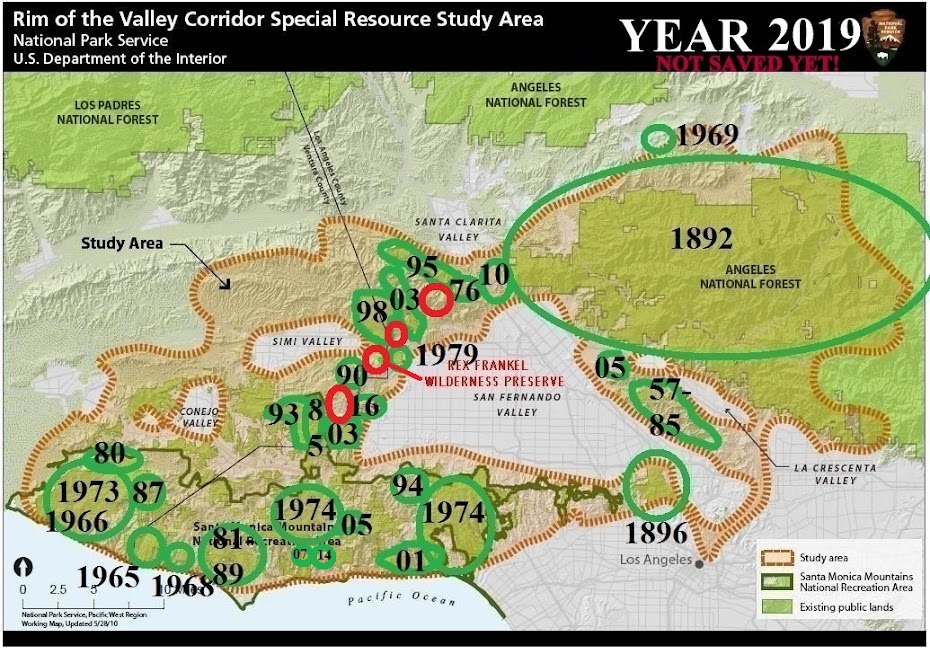
L.A. County does not have any UGB’s. As the county is mostly built-out, there are only a few areas facing significant development pressure that are not within an existing city’s limits. Two notable exceptions are the western Santa Clarita Valley which is owned by the currently bankrupt Newhall Land Company, and the Exxon-Mobil owned parcel in the Chino Hills wildlife corridor in the far eastern county.

Leading the charge in preserving land, the Santa Monica Mountains Conservancy and sister agency the Mountains Restoration and Conservation Authority have helped to preserve over 60,000 acres of parkland in both wilderness and urban settings linking a ring of preserved lands surrounding the sprawl of L.A. County. See http://smmc.ca.gov/ or http://mrca.ca.gov/ for more information.

---------------------------------

Orange County:

City of San Clemente
11/2008: Voters approved a measure prohibiting rezoning or development of open space lands without voter approval

City of San Juan Capistrano
11/2008: Voters showed their support of open space by approving Measure X, which prohibits any change in designation of open space lands without voter approval


--------------------

San Diego County:

City of Escondido—vote required for major projects within the existing city boundaries since 1998.

http://findarticles.com/p/articles/mi_m0BYL/is_/ai_n25032454

Tuesday, December 16, 2008

-
Superior Court Kills Las Lomas Development on L.A. Wildlife Pinchpoint


(click on map to enlarge)

Is the Las Lomas development 'finally dead'?
December 16, 2008, L.A. Times

By Jennifer Oldham
http://www.latimes.com/news/local/la-me-laslomas16-2008dec16,0,6500693.story

A Los Angeles Superior Court judge has declined to order the city to reopen its environmental review of a controversial 5,553-home development proposed for steep hillsides near where Interstate 5 and the Antelope Valley Freeway intersect. Judge David P. Yaffe ruled that state law doesn’t require the City Council to finish preparing environmental studies before considering a proposal by developer Dan Palmer to build a mixed-use community known as Las Lomas. Yaffe’s ruling, issued Friday, led City Councilman Greig Smith — who headed an effort to dismiss the city’s review of the 555-acre project — to declare that “after six years of fighting this ill-conceived project, it appears to be finally dead.” The council voted 10 to 5 in March to instruct the Planning Department to stop processing the application to build the project, which would have included more than 2 million square feet in commercial space. Palmer sued the city last summer, claiming the decision violated state law and the developer’s constitutional right to due process. The complaint asked the court to order the city to finish complex environmental studies and to award it $100 million in damages. Council members feared that the development -- under which Palmer proposed that Los Angeles annex the 555-acre parcel so he could access the city’s water supply -- would tax already overburdened services and further snarl traffic.


Sunday, November 30, 2008

-
Ventura County Sprawl Fighters Not Resting on their Accomplishments

http://soarusa.org/

Between 1995 and 2000, voters in Ventura County overwhelmingly approved a series of ballot measures – the SOAR initiatives – which effectively created the most comprehensive protection against urban sprawl of any county in the United States.


In contrast to Los Angeles and Orange counties, Ventura County has not turned into a single large urban mass. Our cities remain distinct, each with a unique sense of identity and place, defined in no small measure by the intact expanses of open space and farmland that surround them.

Analysis by the countywide SOAR organization determined that today, one in four acres of open space and agricultural land is at risk of sprawl development within the next 10 to 20 years, and much more will be at risk if the SOAR boundaries are allowed to expire.

To read the full 32-page report, go to http://soarusa.org/and click on the "At Risk Report" link


Wednesday, November 5, 2008

-
SF Bay Area Voters Go Green in a Big Way!


VOTERS SUPPORT GREEN TRANSPORTATION, LAND CONSERVATION

11/5/2008
http://greenbelt.org

Great news! On November 4, Bay Area residents overwhelmingly voted to invest in green
transportation and to protect farmland and natural areas. Greenbelt Alliance, with your support, worked hard to pass these six key measures.

California, once the heartland for the automobile, is bringing back its trains. Voters said yes to building a high-speed train, the first in the nation, and to bringing passenger train service from Cloverdale to Larkspur to relieve unrelenting congestion in the North Bay.

Another important victory is the protection of almost 1 million acres in Solano and Napa counties. And Measure WW passed, which will renew funding to create and improve East Bay parks, and preserve open space at the former Concord Naval Weapons Station.

Here are the big wins for the Bay Area's open spaces and vibrant places:

GREEN TRANSPORTATION WINS!
**Proposition 1A (52.3%) authorizes a high-speed train to be built from San Francisco and
Sacramento to San Diego.
**Measure Q (69.5%) brings the SMART train and bike trail to Sonoma and Marin.
**Measure VV (71.5%) provides funding for AC Transit to help preserve affordable public
transportation.

OPEN SPACE VICTORIES!
**Solano's Measure T (69.6%) guides growth into existing cities and protects 440,000
acres of agricultural and natural areas.
**Measure P (63.7%) protects 540,000 acres of Napa County farmland and watersheds.
**Measure WW (71.5%) creates parks, builds trails, and restores ecological areas in the East Bay.

Thanks for helping to make these victories possible; they will lead the Bay Area to a
more sustainable, self-sufficient future.

Monday, April 21, 2008

-----
2 stories:
Sprawl is closing the gap between cities and suburbs across Northern, Calif., putting a strain on the environment.

Growth Control Victories in the North SF Bay
--------------------

Creeping sprawl overtakes refugees from cities

By Rachel Gordon, San Francisco Chronicle, 4-18-2008

http://www.sfgate.com/cgi-bin/article.cgi?f=/c/a/2008/04/18/BA0GVRQLO.DTL&type=green

Fed up with the encroaching sprawl, Linda Jimenez fled Silicon Valley for Tracy in 1990 in search of more affordable housing and the small-town way of life of her Santa Clara County youth. Eventually, the sprawl caught up.

In 1990, Tracy, a friendly agricultural community separated from the Bay Area by the Altamont Pass, had fewer than 34,000 residents. Today, the mushrooming town, located at the western gateway to the Central Valley, has a population nearing 81,000.

The town sits as a symbol of the quest by working- and middle-class Bay Area residents to find housing they can afford - a pursuit that often draws them further from the traditional job centers in San Francisco, Oakland and San Jose.

The result: A swath of residential and retail development that reaches toward the Sierra foothills, into the agricultural heartland of the Central Valley and south toward Salinas on land once reserved for ranching, farming and recreation.

The migration comes at costs to the environment: loss of natural habitat, increased greenhouse gases and a growing strain on the watershed.

"Sprawl is an inefficient and unsustainable use of our land resources," said Elizabeth Adam, spokeswoman for the Bay Area Open Space Council. "It is often the default pattern of development that solves short-term problems but has very negative effects on communities over time."

Just drive along major highways between Richmond and Auburn (Placer County), between Dublin and Manteca (San Joaquin County), between San Jose and Salinas and between Sacramento and Stockton, and the change is evident, with strip malls, office parks and cookie-cutter housing projects dotting the landscape.

"The cities and suburbs of Northern California are increasingly growing together," Gabriel Metcalf and Egon Terplan noted last year in a San Francisco Planning and Urban Research Association report on the development trend they wrote. "Growth has outstripped the traditional nine-county Bay Area and has leapt north, south and east, joining with Sacramento and its suburbs."

The Bay Area's population, now estimated at 7.2 million, is projected to grow to 8.7 million by 2030, according to the California Department of Finance. But the population growth in the Bay Area's 12 neighboring counties - among them San Joaquin, Sacramento, Stanislaus and Santa Cruz - is projected to add even more people. By 2030, according to the state forecast, they will have 6.6 million residents, an increase of 2.1 million.

One of the chief problems is that the jobs have not been keeping up with the trend, forcing more people to endure long commutes.

"Between 1980 and 2000, the number of commuters from 12 neighboring counties into the Bay Area's nine-county core nearly quadrupled from 30,000 to 117,000 daily," Metcalf and Terplan found. "Given that the vast majority of commuters were driving alone, nearly 90,000 new cars were added to already-congested roadways from trips alone."

Vehicle emissions account for half the greenhouse gas emissions in California.

Jimenez, who works for Cal State East Bay, spends more than 2 1/2 hours a day in her car, driving back and forth between her home in Tracy and her job in Hayward. For a while, she took public transit - a mixture of BART and buses to reduce her carbon footprint - but that nearly doubled her commute time. She switched back to driving, but bought a less environmentally damaging hybrid car.

Despite the long commutes, Jimenez, 57, doesn't regret her decision to leave the Bay Area.

When she purchased her first home in Tracy in 1990, she paid $154,000 for a spacious, three-bedroom, two-bathroom house. Fourteen years later she sold it for more than $400,000 and traded up for about $100,000 more to a five-bedroom, three-bath house with a large yard that she shares with her daughter, son in-law and grandchildren. Finding a house that size and at that price in the Bay Area, in a place as nice as Tracy, she said, would be difficult.

"I agree it's not the ideal situation, but we like the community and have established roots here," Jimenez said.

San Joaquin County, where Tracy is located, has undergone a major transformation in the past decade and a half. An estimated 115,196 acres of open space and agricultural land have been "urbanized," or developed for commercial and residential use, according data kept by the state Department of Conservation.

Statewide, an estimated 538,273 acres were developed between 1990 and 2004, or 38,448 annually. Nearly two-thirds of the development was on land once used for agriculture.

Between 1849 - the start of the Gold Rush - and 1990, an average of 20,052 undeveloped acres were urbanized annually.

Unless restrictions are placed on new development, an estimated 2.1 million acres in California, much of it supporting crops and grazing, is at risk of sprawl development, according to the American Farmland Trust, a national preservation group.

The loss of open space has altered California's economy and ecosystem.

"We're losing migration corridors for animals and compromising our watersheds and paving over productive farmland," said Amanda Brown-Stevens, field director for Greenbelt Alliance, a Bay Area land conservation and urban planning organization.

The challenge, she said, is getting people to value long-term sustainability more than short-term profit. If they won't do it on their own, then land-use laws can be enacted to prevent landowners and builders from developing open space.

Across the country, local jurisdictions have adopted urban-growth boundaries aimed at curtailing sprawl. In the Bay Area, such limits have been enacted in approximately three dozen cities and counties, from Morgan Hill to St. Helena. Vacaville, as part of a legal settlement with conservationists, was the latest to limit growth.

Greenbelt Alliance (http://greenbelt.org) has calculated that 401,500 acres of open space lands in the Bay Area could be developed in the next 30 years, with the growth hot spots centered along Interstate 80 in Solano County, eastern Contra Costa County, the East Bay's Tri-Valley area, Coyote Valley in southern Santa Clara County and Highway 101 in the North Bay through Sonoma County.

Brown-Stevens said the demands of population growth and the search for affordable housing can't be ignored. However, she said, there are development options that are less harmful to the environment than building on remote open lands.

One such option, she said, is the construction of compact residential developments with a mix of condos, single-family homes and apartments in cities. Ideally, they would be near stores and job centers and have easy access to public transit to make it more convenient for people to get around without driving.

But convincing people that the American Dream can be found in an urban neighborhood where sometimes the only open space is the back stoop or the neighborhood playground won't be easy.

Still, Brown-Stevens suggested that the time is right to make the argument.

"I think people are sick of traffic," she said, "and they do care about the issue of global warming, and they do want to spend more time with their families and spend less time in their cars."

----------------

Victory: Pittsburg City Council rejects flawed hillside ordinance!
On Monday April 8, Pittsburg's City Council rejected a flawed hillside ordinance and sent it back to the city planning staff to completely redo. Greenbelt Alliance and local residents have been working for a full year to get the Planning Commission to create an ordinance that truly protects the hills instead of opening them up for grading and sprawl development. This is a major victory and an important opportunity to protect these iconic East Bay hills.


Success: Vacaville adopts urban growth boundary!
On Tuesday March 25, the City Council in Vacaville, one of Solano County's fastest-growing cities, unanimously adopted an urban growth boundary! The petition for the boundary was signed by 10,000 Vacaville residents (more than voted in the last election). The boundary defines where growth should and should not occur, and will protect thousands of acres of farmlands and hills around the city.

Tuesday, March 4, 2008

-----

Tassajara Valley Urban Limit Line Threat; Calling Urban Sprawl "rural" Doesn't Make it So

3-4-2008

Voters approved the Contra Costa County Urban Limit Line (ULL) in November 2006, putting Tassajara Valley off-limits to development. However, developers recently proposed a 193-unit housing development outside the ULL on a 770 acres of land east of San Ramon and Danville.

County Supervisors agreed to review the proposal, setting a bad precedent, as they were essentially agreeing to consider allowing suburban development outside the ULL.

If this proposal is accepted, it could open the floodgates for similar development proposals throughout Contra Costa County, putting thousands of acres of land at risk.

What's at Stake

The current proposal, entitled New Farm, attempts to skirt the law by not requiring the County to physically alter the ULL. Instead, the developer is attempting to convince County Supervisors that the proposed housing development project is “rural” in nature.

But New Farm is not rural, and it’s no farm.

The proposal blatantly breaks the ULL by extending water and sewage lines across the line. Rural development has traditionally been defined as parcels using septic tanks and wells, whereas urban development requires the construction of public utilities—such as water and sewage lines.

The New Farm 193-unit proposal will allow massive development on prime agricultural land. On the land, only one housing unit per 80 acres is currently allowed, to support true farms. But the New Farm proposal would subdivide the land into 5-acre parcels. The developer is even requesting “density bonuses” for consolidating development on 40 acres, to allow more units.

The proposal is sprawl development, pure and simple.

Even if it were a better proposal, New Farm is in the wrong place. Contra Costa County voters agreed on a growth boundary with the understanding that no urban or suburban development would be allowed beyond that point until at least 2020, at which time the General Plan will be reevaluated.

Calling this project “rural” is a transparent attempt to get around the law, and is in clear opposition to the will of the people of Contra Costa. Greenbelt Alliance opposes this threat to farmland, and to the policies protecting farmland and natural areas.


FOR THE FULL STORY:

http://www.greenbelt.org/regions/eastbay/camp_tassajara.html

http://www.redorbit.com/news/politics/1024376/voterapproved_urban_limit_line_faces_challenges/index.html

Monday, February 18, 2008

-----
Stanislaus County voters back Stamp Out Sprawl Initiative

By GARTH STAPLEY
February 06, 2008

http://www.modbee.com/local/story/203272.html

Both Stanislaus County growth measures sailed toward victory late Tuesday, with the more restrictive appearing to be more popular.

That's important because the one with the most "yes" votes will become law, while the other dies.

Measure E, which wrests control from county supervisors over housing projects in unincorporated areas, captured 47,177 "yes" votes, or 66.93 percent, and 23,305 "no" votes, or 33.07 percent, with 100 percent of precincts reporting.

Voters also liked its rival, Measure L, but awarded it only 44,729 "yes" votes, or 63.42 percent.

Measure E, also known as Stamp Out Sprawl, becomes the first successful growth initiative stretching across Stanislaus County. For 30 years, supervisors cannot change agricultural zoning for housing projects in unincorporated areas without ballot permission from county voters.

By contrast, Modesto's growth initiatives, approved in 1979 and 1997, require citywide votes but are not binding on the city's leaders.

"I'm quite confident at this point," said Modesto City Councilman Garrad Marsh. He teamed with former Councilman Denny Jackman to champion Measure E.
Supporters say Measure E should channel growth into the county's nine cities, which are better equipped to provide municipal services such as water, sewer and police.
The county gives millions of dollars in subsidies each year to noncities including Salida, Keyes and Denair, whose retail districts don't produce enough taxes to cover services required by townsfolk.

Took 2 years to get on ballot

People concerned about increasing traffic, air pollution and other aspects of rapid growth gathered about 16,000 signatures in 2006 to qualify Measure E for the ballot. But supervisors, faced with losing some long-held power, stalled it long enough to delay a countywide vote for nearly two years.

Meanwhile, developers put out big money to similarly qualify an initiative allowing Salida, the county's largest unincorporated community, to someday double its population of 14,000 and add huge shopping centers. And supervisors saved them the trouble by approving the growth plan outright, negating the need for a vote of the people.
But supervisors weren't done yet. They prompted staff to craft Measure L, a ballot counterstrike to Measure E.

Measure L called for supervisors to appoint a commission of volunteers to update the county's general plan, which guides growth. Voters later would weigh in on the rewrite, and officials could continue guiding growth with comprehensive power rather than subjecting the county to piecemeal, ballot-box planning.

But county officials said they're so proud of Measure L's provisions that they intend to adopt them this year regardless of Tuesday's outcome.

Measure E over Measure L

Measure L failed to capture widespread support, enlisting only the Stanislaus County Farm Bureau and prompting no fund raising.

Measure E did not fare much better, but garnered endorsements from the League of Women Voters of Stanislaus County and The Bee's editorial board.
The Bee also compiled housing permit statistics showing that despite county officials' claim of channeling residential growth to cities, they approved 2,939 houses in unincorporated areas since 2000. The number collectively represents more homes than are in the cities of Waterford or Hughson, which have 2,574 and 1,907 homes, respectively.

Voters largely were sympathetic to both measures, according to Tuesday's results, but 2,390 more -- of about 58,000 counted by 11 p.m. -- apparently favored Measure E over L.

Marsh said the measure's formal titles, chosen by county attorneys, may have misled some voters. He said Measure E's title, "Thirty Year Land Use Restriction Initiative," sounds much more harsh than L's "Stanislaus County Responsible Planning and Growth Control Initiative."
"All that matters is the one with the most 'yeses,' " Marsh said.

-------------------------
2 Growth Measures Fight It Out on Ballot

By Garth Stapley, The Modesto Bee, Calif. 1/20/2008

Jan. 20--Growth, one of the area's most important challenges, makes its way onto a Stanislaus County ballot next month for the first time since 1992 with two competing measures.

Despite millions of dollars riding on the outcome, those with the most at stake, homebuilders, largely are sitting out the debate over Measures E and L. They hate both.
If either passes, county supervisors stand to lose the most in terms of control over growth decisions. They have worked hard to negate Measure E and are trying to derail it with Measure L, which would siphon off less of their power.

Some say county leaders hope to confuse people, who might vote "no" on both when confronted with two options on an irritating topic. But make no mistake: They are very different measures.

One, Measure E, was written by longtime controlled- growth advocates and qualified for the ballot in 2006 after about 16,000 voters signed petitions. The League of Women Voters supports this initiative.

The other, Measure L, was written by appointed county officials and placed on the ballot by their bosses, county supervisors, as a less-offensive (to them) counterstrike to Measure E. The Stanislaus County Farm Bureau favors this option.

Neither side has raised money or is actively campaigning, though backers of Measure E produced a leaflet and a newspaper ad, and wrote a couple of pieces for The Bee's Opinions pages.

If both fail Feb. 5, supervisors would be free to continue with housing projects in unincorporated areas as they have in the past. If voters approve both measures, only the one with the most "yes" votes will become law.

Measure E

Modesto City Councilman Garrad Marsh and former Councilman Denny Jackman are the authors of the initiative, formerly known as Stamp Out Sprawl, and no one submitted a ballot argument opposing it. The measure would require countywide votes of the people to convert farmland for housing projects in unincorporated areas.

County supervisors managed to stall this initiative for nearly two years, giving them time to approve a hefty Salida growth plan -- without a vote of the people -- and time to come up with a watered-down countermeasure.

What's good about Measure E:

It should drive growth into cities, which are better able to provide efficient urban services: sewer, water and law enforcement, for example.
Less growth in the country means more farmland preservation, supporters say.
Fewer badly planned towns would cut down on millions of dollars each year of county subsidies to those unincorporated urban areas.

What's bad about Measure E:

Wresting control of growth from supervisors, critics say, unwittingly places it in the hands of developers. They might sway public opinion with slick, expensive campaigns.
"Whoever has the most money," said Kevin Chiesa, president of the Stanislaus County Farm Bureau.

Loss of local control.

Because much of the county's population is concentrated in a few cities, voters there might control outlying areas. For example, voters in Modesto and Turlock could kill sensible projects near Newman or Knights Ferry, whose people would proportionately have little say.

"The initiative would result in mob rule and ballot-box planning," said Steve Madison, executive vice president of the Building Industry Association of Central California.
No restrictions on ranchettes, a low-density form of sprawl abhorred by most people in favor of slow growth.

Measure L

County officials placed it on the ballot, but are prevented by state law from actively campaigning. The measure would create a 15-person commission charged with rewriting the county's general plan, a document guiding growth.

What's good about Measure L:

Passage would start a two-year moratorium on new homes in unincorporated areas, except those already in the pipeline.

People throughout the county would vote on the new general plan, a departure from supervisors' normal power. And future changes would require a four-fifths "supermajority" vote of supervisors, up from the current three-fifths standard.
Supervisors could continue making decisions with the good of the entire county in mind, as opposed to developers pushing individual projects.

What's bad about Measure L:

No guarantees.
First, the measure calls for a broad cross-section of the community to serve on the 15-member general plan rewrite commission. But supervisors would appoint all of the members.

Second, the measure's guidelines are squishy on what the rewrite commission should do. It repeatedly states that members would "consider" various growth-control suggestions.
Third, supervisors could have the final say after all. If the commission produced a poor rewrite and voters turned it down more than once, supervisors ulti- mately could impose their will.
"We're not convinced the Board of Supervisors has the capacity to use the input they receive," said Madison. The builders association on Wednesday sued the county over new rules requiring developers to preserve an acre of farmland for every acre consumed by homes.

Bad track record.

Even if voters approved a new general plan, it still would be up to supervisors to use it when considering growth proposals. Critics claim that supervisors for years have given lip service to channeling growth to cities, while approving thousands of homes in the country.

"Every time the supervisors have done it, it has been fairly significant and disastrous," Marsh said. About half of the county's underfunded housing developments are unincorpor-ated islands surrounded by Modesto, he noted.

The moratorium would not apply to many thousands of homes already proposed, principally in Salida and Keyes.

It's entirely redundant.

State law suggests a general plan rewrite every five to 10 years. It's been 14 in Stanislaus County.

Before putting L on the ballot, the county had planned to start a rewrite this year, said Planning Director Ron Freitas. His people have been collecting a special fee for several years to pay for studies and consultants.

County Chief Executive Of- ficer Rick Robinson said he believes so strongly in provisions of Measure L that he would ask supervisors to adopt them even if it fails at the ballot box.

"One (E) is action," Jackman said. "One (L) is a continuation of the status quo."

LA meetuphikes.org

E-Mail the editor:

rexfrankel at yahoo.com

Blog Archive

Quick-Search of Subjects on the Site